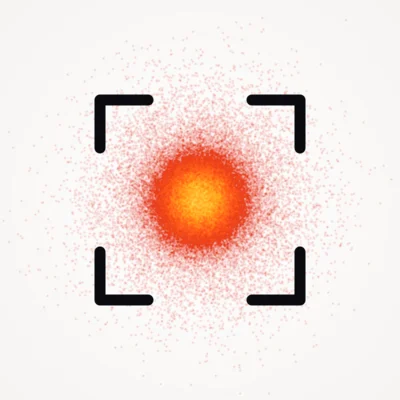
A screen pixel has a ceiling: full white. The sun in one 1995 test picture was about 15 million times brighter than a monitor's white back then. Draw a star honestly and once it hits white, it stops looking brighter: a white dot just looks white. That year Greg Spencer, Peter Shirley and colleagues asked what a small light bulb has that a white pixel doesn't: "the hazy glow that can be seen around the bulb". It isn't only a camera flaw. Your own eye scatters light in the cornea, lens and retina, which makes bloom, fine needles and even a coloured ring. So they painted the glare your eye would make, only from the light the screen couldn't show. The pixel stays white; the glow tells your brain it is brighter. In a 2012 lab test, pupils even shrank at glowing pictures that gave off no more light than plain ones. And Pixar describes Joy as "like a bright yellow light bulb", and gave her a halo.
The star, bulb and eyes here are our own drawings, not images from any film.
Which movie trick should we take apart next?
Sources: Spencer, Shirley, Zimmerman and Greenberg, "Physically-Based Glare Effects for Digital Images", SIGGRAPH 1995; Yoshida, Ihrke, Mantiuk and Seidel, "Brightness of the glare illusion", APGV 2008; Laeng and Endestad, "Bright illusions reduce the eye’s pupil", PNAS 2012; Lacaze et al., Inside Out 2 talk, SIGGRAPH 2024 (Pixar).
Sounds: Apple iMovie sound effects.