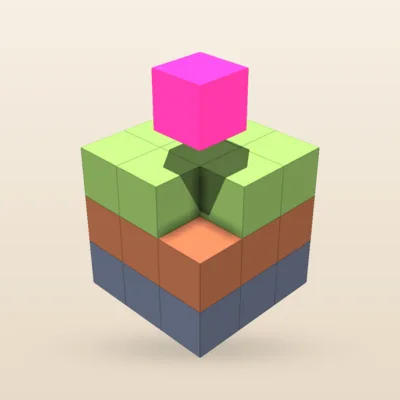
Players call them the Far Lands. In 2011 Minecraft built its ground from smooth random numbers, fresh for every spot you reach. Markus Persson, Minecraft's creator, wrote that year: "My gut feeling is that nobody ever has so far, and nobody will. Walking that far will take a very long time." That same year Kurt J. Mac set off walking in Far Lands or Bust, and in 2025 got there: "We did it."
The rules are the same out there. What breaks is one number. The game's terrain code (Beta 1.7.3) multiplies your spot by 171.103, adds a small offset, and splits the result: the whole number is the square of its noise grid you're in, the rest is how far across it, from 0 to 1. That whole number is a Java int, and an int stops at 2,147,483,647. Around block 12,550,821 the number fills up and sticks, so "how far across" takes the rest: hundreds, then thousands. The smooth blend built for 0 to 1 answers with sixteen digits, and next to that the rule that keeps the sky empty is nothing. Only the sign is left: plus is stone, minus is air. And because the stuck number picks the same pattern in every column, the stripes run on: walls with long holes, all the way to the top of the world. Programmers call it an overflow. It's not a rounding error.
The world in this film is our own simplified version, built in code from Beta 1.7.3's terrain rules with our own random tables, one climate and no caves. The walker is our own toy block.
Which game should we walk to the edge of next?
Sources: Minecraft Java Edition Beta 1.7.3 terrain code (NoiseGeneratorPerlin, NoiseGeneratorOctaves, ChunkProviderGenerate, read in two decompiles). The Java Language Specification, section 5.1.3. Markus Persson, "Terrain generation, Part 1", The Word of Notch, March 9, 2011 (archived copy). Kurt J. Mac, farlandsorbust.com and "FLoB-a-Thon 2025 - Day 69 - THE FAR LANDS" on YouTube.
Not an official Minecraft video. Not approved by or associated with Mojang or Microsoft.
Sounds: Apple iMovie sound effects.