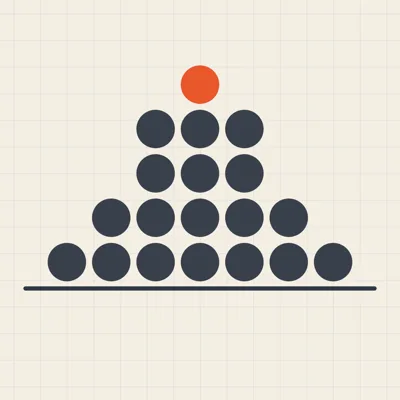
In 1906, at a livestock show in Plymouth, England, people paid sixpence each to guess what a fat ox would weigh once butchered. The statistician Francis Galton borrowed the 787 readable cards. A typical guess was about 60 pounds off. Galton took the middle guess, the way a vote would: 1,207 pounds, against the 1,198 he printed for the ox. Within one per cent. When a reader asked for the plain average, Galton worked it out: 1,197. In 2014 the economist Kenneth Wallis went through Galton's papers and found the organiser's letter: the ox had weighed 1,197 pounds. Galton had copied the number wrong, and the crowd's average was right to the pound. Galton never noticed: his 1908 memoir repeats the old numbers.
Why it works: every guess is the truth plus a mistake. When people guess on their own, the mistakes point both ways and cancel. When they copy each other, they stop cancelling.
The ox and the dots are our own drawing; the guesses are recreated from the percentile table Galton published. Galton also founded eugenics, a movement now rightly rejected. This story is about his data.
What was your guess?
Sources: Francis Galton, "Vox Populi", Nature 75, 450-451 (1907); "The Ballot-Box", Nature 75, 509-510 (1907); Kenneth F. Wallis, "Revisiting Francis Galton's Forecasting Competition", Statistical Science 29(3), 420-424 (2014).
Sounds: Freesound, CC0 (magnus1906, kyles, spurioustransients, deraj, rabbydaw, Joao_Janz, Diboz, brunoboselli); Apple iMovie sound effects.