In 1927, at the Royal College of Physicians Laboratory in Edinburgh, two Scots worked out why an epidemic ends: Anderson McKendrick, a doctor who had served in India, and William Kermack, a chemist blinded by a lab explosion three years before. Most people thought an epidemic stops when everyone has had it, or when the germ grows weaker. Their equations said neither.
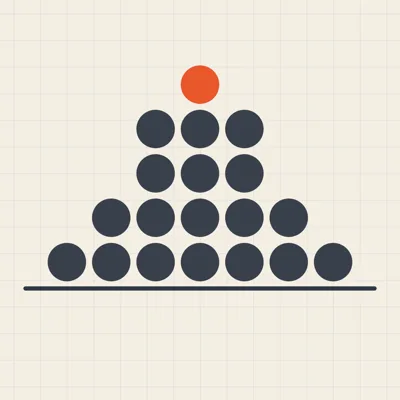
Say each sick person would pass it to two others in an untouched town. Nobody catches it twice, so everyone who has had it is one fewer to pass it to. When half the town has had it, each sick person finds half as many who can still catch it: two becomes one, and the wave turns. Below one it rolls on, slower and slower, and stops with about 800 infected and 200 never touched.
They called the turning point a threshold: below it, a sick person is more likely to recover than to pass it on. Today the number of new cases per case is called R; the 1927 paper speaks of a threshold.
Our town is one run of their simplest model, in which everyone mixes evenly, everyone is equally likely to catch it and nobody catches it twice. Real outbreaks are messier. Started by one case, nearly half of our runs died out early. Their own test was plague deaths in Bombay in 1905 and 1906, a fit they called a very rough approximation; a 2012 study argues that wave ended with the season.
So, what did you guess?
Sources: W. O. Kermack and A. G. McKendrick, "A Contribution to the Mathematical Theory of Epidemics", Proceedings of the Royal Society A, 1927; MacTutor History of Mathematics, biographies of Kermack and McKendrick; N. Bacaër, Journal of Mathematical Biology, 2012.
Sounds: our own, made in code (earshot, CC0).